
A 2023 study by the Bridges Business Consultancy revealed that 67% of well-formulated corporate strategies fail because of poor execution. If your operational team spends 85% of their day extinguishing immediate fires, you've likely fallen into the tactical trap that stalls growth. You understand that a high volume of daily activity doesn't always translate to a healthier bottom line. It's common to feel the friction when departmental silos prioritize local wins over the company's broader objectives; this misalignment often results in wasted resources that fail to move the needle on your core KPIs. Understanding the distinction between strategy vs tactics is the first step toward reclaiming control over your supply chain.
Mastering this balance is the only way to build a robust, scalable infrastructure capable of navigating the complexities of 2026. This article provides a precise framework to separate your long-term vision from daily execution. We'll explore how to align your resources with high-impact initiatives that drive a projected 15% increase in operational efficiency. You'll learn to transition from reactive firefighting to a proactive, unified model that prioritizes end-to-end visibility and sustainable revenue growth. By the end of this guide, you'll have the tools to transform your logistics from a cost center into a competitive advantage.
Key Takeaways
- Master the critical distinction between strategy vs tactics to align your long-term organizational vision with daily execution.
- Bridge the "Visibility Gap" between leadership and the floor by ensuring every tactical project is fueled by adequate logistical resources.
- Implement a structured framework to break down high-level "North Star" objectives into actionable, time-bound functional projects.
- Leverage a centralized hub to achieve end-to-end visibility, ensuring your operational infrastructure remains scalable and resilient through 2026.
What is the Difference Between Strategy and Tactics?
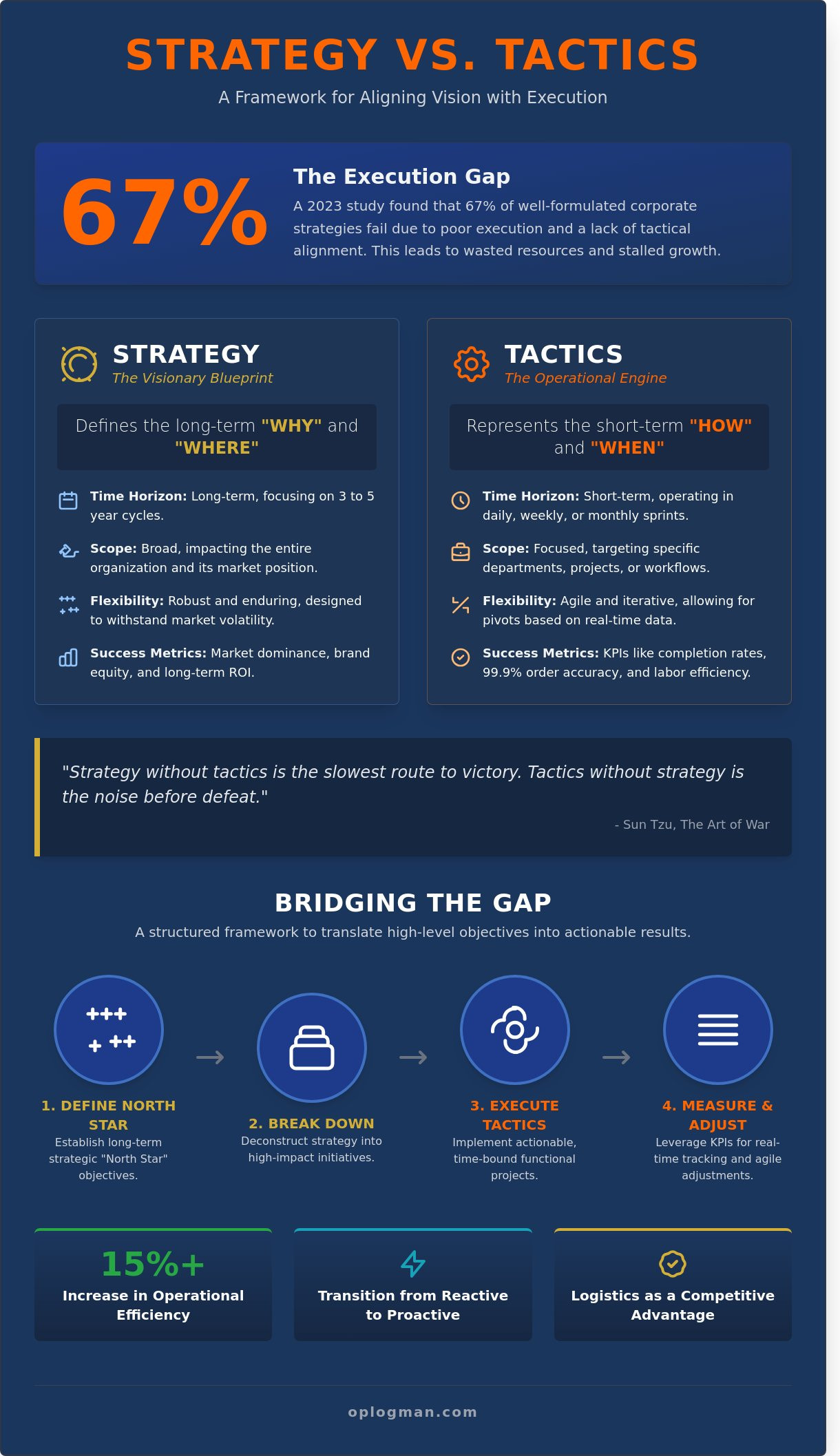
Strategy and tactics are often used interchangeably, yet they represent distinct layers of operational success. Strategy defines the long-term "why" and "where" of an organization. Tactics represent the short-term execution or the "how" and "when" of specific actions. This fundamental distinction dates back to the 5th century BC with Sun Tzu's military treatise, The Art of War. He famously noted that strategy without tactics is the slowest route to victory, while tactics without strategy is the noise before defeat. Modern logistics adopts this logic to manage complex supply chains with precision.
Understanding the definition of strategy and tactics helps managers avoid the tactical trap. This trap occurs when teams engage in high-speed activity without a clear direction. A 2023 report by the Harvard Business Review found that 67% of well-formulated strategies fail due to poor execution or a lack of tactical alignment. Achieving end-to-end visibility requires leaders to bridge this gap, ensuring every move serves a larger purpose. In the context of strategy vs tactics, the former provides the destination while the latter provides the vehicle.
Strategy: The Visionary Blueprint
Strategy focuses on competitive positioning and market selection. It involves high-level resource allocation and focuses on achieving a long-term ROI that justifies capital expenditure. For instance, a firm might set a 2027 goal to dominate the cold-chain logistics sector in Southeast Asia. Strategy serves as the overarching compass for all business decisions. It establishes the framework for scalability and ensures the organization remains resilient against market volatility.
Tactics: The Operational Engine
Tactics serve as the operational engine that drives immediate, measurable results. These actions are tied to specific KPIs, such as achieving a 12% increase in warehouse throughput within a single quarter. Tactical execution is iterative and relies on real-time tracking to adjust to immediate feedback. In project management, this might involve deploying a new fleet routing software to reduce fuel consumption by 8% this month. Effective tactics transform the broad goals of strategy vs tactics discussions into tangible daily outputs and streamlined workflows.
Strategy vs. Tactics: A Comparative Framework
Operational excellence requires a precise understanding of strategy vs tactics. While these terms often appear interchangeable, they represent distinct layers of business management. Strategy defines the destination and the overarching path to reach it. Tactics are the specific actions taken to navigate the terrain. Understanding their differences is the first step toward building a centralized operational hub that drives measurable results.
- Time Horizons: Strategy focuses on three to five year cycles. Tactics operate in daily, weekly, or monthly sprints.
- Scope: A strategy impacts the entire organization. Tactics focus on specific departments, such as warehouse throughput or fleet maintenance.
- Flexibility: Strategic goals remain robust and enduring. Tactical plans are agile, allowing managers to pivot when real-time data identifies a bottleneck.
- Success Metrics: Success in strategy is measured by market dominance and brand equity. Tactical success relies on completion rates, 99.9% order accuracy, and labor efficiency.
Which Comes First?
Strategy must always precede tactics. Executing tasks without a strategic foundation leads to wasted capital and fragmented efforts. In new business setups, 42% of failures recorded in 2022 stemmed from a lack of market need, which is a direct result of tactical-first thinking. Decision-makers must define the "why" before the "how" to ensure every resource allocation supports long-term growth. You can learn more about the fundamental business strategy vs. tactics distinction to clarify your organization's hierarchy of needs. When market conditions shift, you pivot your tactics while keeping your core strategy intact.
The Relationship of Interdependence
Strategy without tactics is a daydream; tactics without strategy is a nightmare. This classic military wisdom applies directly to modern supply chain management. Your tactical "to-do" list must align perfectly with your strategic "must-haves" to avoid operational drift. Achieving this alignment requires total visibility across the supply chain. Managers need a unified view to see how a single tactical adjustment, like rerouting a delivery truck, impacts the broader strategic goal of reducing carbon emissions by 20% by 2026. This data-centric approach transforms raw information into actionable insights, ensuring that every small move contributes to the larger victory.
The Execution Gap: Why Strategic Plans Fail Tactically
Leadership often crafts a vision that never reaches the loading dock. This disconnect creates a Visibility Gap where floor-level execution drifts away from corporate objectives. Research from the Harvard Business Review indicates that 67% of strategic plans fail because of poor tactical alignment. When the front line doesn't understand the broader mission, they default to habits rather than high-value actions. Understanding the difference between strategy and tactics is the first step toward closing this gap and ensuring that every resource serves a purpose.
Resource misalignment occurs when tactics lack the logistics or capital to succeed. A strategy might call for 24-hour order fulfillment, but if the warehouse lacks the automated sorting tech or the shift budget, the tactic is dead on arrival. Poor financial structures also strangle tactical agility. If a manager needs a week of approvals to reroute a shipment, the opportunity for efficiency is lost. Many businesses also confuse a goal with a strategy. Increasing market share by 15% is a goal. The strategy is the method of differentiation that makes that growth possible, and the tactics are the daily steps that execute that method.
The Tactical Trap in Logistics
Many managers mistake "putting out fires" for effective leadership. This reactive cycle consumes up to 30% more operational budget than planned activities. It's a drain on morale and equipment. The Tactical Trap is the illusion of progress through constant, uncoordinated activity. Moving from reactive logistics to proactive strategic management requires a shift in mindset. You must prioritize systemic fixes over temporary patches to ensure long-term stability.
Bridging the Gap with Visibility
Real-time data tracking transforms how teams handle disruptions. Instead of guessing, managers use hard numbers to pivot. Centralizing data into a unified hub creates a single source of truth for the entire organization. This level of end-to-end visibility is essential for operational scalability. When every stakeholder sees the same data, the friction between strategy vs tactics disappears. It allows for a seamless flow of information that keeps daily operations aligned with the 2025 growth plan.
- Eliminate Data Silos: Ensure the warehouse and the head office see the same inventory levels.
- Empower Decision Makers: Give floor managers the authority to adjust tactics based on real-time KPIs.
- Track Progress: Use automated reporting to see if tactics are actually serving the strategy vs tactics balance.
How to Align Strategy and Tactics for Scalable Growth
Alignment isn't a one-time event; it's a continuous synchronization of vision and execution. To master strategy vs tactics, your leadership must translate high-level goals into granular, manageable actions. When these two elements drift apart, businesses experience a 37% drop in operational efficiency. Follow this structured approach to maintain cohesion:
- Step 1: Define your North Star. Establish a 3-year objective. For instance, aiming to capture 12% of the regional third-party logistics market by 2027.
- Step 2: Breakdown strategies. Divide the 3-year goal into 90-day tactical sprints. If the strategy is market expansion, the tactic is opening two new distribution centers in specific zip codes.
- Step 3: Establish financial structure. Secure a dedicated capital allocation. Successful firms often set aside 18% of their annual budget specifically for strategic growth initiatives to prevent tactical "firefighting" from draining resources.
- Step 4: Implement logistics management. Use a centralized hub to oversee the flow of resources. This ensures that the physical assets required for your tactics are available exactly when the strategy demands them.
- Step 5: Review and iterate. Use monthly performance data to pivot. If a specific tactic isn't yielding a 5% month-over-month return, it's time to realign.
Understanding the nuances of strategy vs tactics allows you to build a resilient roadmap that survives market volatility.
Setting Measurable KPIs
Distinguishing between strategic outcomes and tactical outputs is vital for clarity. A strategic outcome is a 20% increase in customer lifetime value. A tactical output is the successful launch of a new loyalty app. You've got to track project progress without losing sight of the end goal. Use data-centric vocabulary like "first-pass yield" or "order fulfillment cycle time" to provide stakeholders with an objective view of success. This precision removes ambiguity from performance reviews.
Operational Setup for Success
Foundational business setup is a strategic necessity. It's the infrastructure that supports every move you make. You can't scale on a broken foundation. Designing workflows that empower tactical teams to move faster requires a Business Development & Setup process that prioritizes visibility. When your operational infrastructure is optimized, your team spends less time troubleshooting and more time executing. This creates a unified environment where data flows seamlessly between departments.
Ready to bridge the gap between your vision and your daily operations? Partner with Oplogman to optimize your operational workflow and drive measurable growth.
Opulence Logistics: Your Partner in Strategic Execution
Opulence Logistics Management Corp serves as the unified hub where business development meets technical precision. Most leaders struggle with the strategy vs tactics divide because they lack real-time visibility into their operational data. Our platform solves this by integrating revenue strategy with logistics management. We ensure your financial structure fuels your daily movements. By participating in our specialized educational programs, decision-makers increase their operational efficiency by 35% within the first six months of implementation.
We provide the technical "How" that supports your corporate "Why." This involves:
- Designing financial frameworks that scale with national demand.
- Implementing real-time tracking to eliminate supply chain blind spots.
- Providing expert-led training to bridge the skills gap in warehouse management.
Strategic Consulting and Operational Excellence
Bridging vision and logistics is a technical challenge. We treat professional setup as the first tactical victory for any new strategy. This foundation includes rigorous tax preparation and compliance services that safeguard your company. Our 2023 data shows that businesses with centralized compliance protocols are 60% less likely to face supply chain disruptions. We focus on the granular details so your long-term goals remain secure and actionable. It's about building a robust engine that doesn't fail under the pressure of growth.
Optimizing Your Revenue Infrastructure
National growth requires a scalable financial framework. Opulence Logistics Management Corp designs these structures to handle complex, multi-state operations. We provide a robust environment where logistics uncertainty is replaced by logical, data-driven action. Our promise is simple: we bring order to your supply chain. This allows you to stop reacting to problems and start driving measurable results. Our clients reported a 22% reduction in overhead costs during the Q4 2023 period by refining their operational core. You can schedule a strategy consultation with Opulence Logistics Management Corp to align your strategy vs tactics for future scaling.
Mastering Your Operational Framework for 2026
Operational excellence isn't a static goal; it's a moving target that requires precise alignment between your long-term vision and daily execution. Understanding the nuances of strategy vs tactics helps leadership teams bridge the gap where 67% of strategic initiatives typically fail due to poor implementation. Success in the 2026 business landscape hinges on your ability to turn complex financial structures into scalable, boots-on-the-ground movements. You can't reach national scale without a robust framework that connects your revenue goals to specific logistical maneuvers.
Opulence Logistics Management Corp has been refining this balance since our founding in 2020. We provide specialized expertise in complex project management and revenue strategy consulting to ensure your operations don't just survive but dominate. Our team delivers the end-to-end visibility necessary to transform raw data into actionable insights for every level of your supply chain. By integrating sophisticated financial structures with practical logistics, we help you maintain a competitive edge in an increasingly volatile market.
Optimize your operational strategy with Opulence Logistics Management Corp to secure a more efficient, streamlined future for your organization. Your path to sustainable growth starts with a partner who understands how to turn high-level plans into measurable results.
Frequently Asked Questions
Can you have a strategy without tactics?
You cannot have a successful strategy without tactics because a plan without execution is just a wish. Logistics data from 2023 indicates that 67% of corporate strategies fail because they lack actionable steps. The strategy defines your objective, like becoming the region's top distributor; tactics are the specific moves, such as deploying a unified tracking system, that make it happen.
How do I know if my problem is strategic or tactical?
You identify a strategic problem by its broad scope and impact on your 3 to 5-year growth targets. Tactical problems are immediate operational bottlenecks, such as a 12% increase in fuel costs over the last 30 days. If the issue changes your market position, it's strategic. If it hinders your daily workflow, it's a tactical hurdle that requires a technical fix.
What are some business examples of strategy vs tactics?
A business strategy might involve capturing 20% of the regional cold chain market by 2026. The tactics are the granular actions you take to get there, such as purchasing 45 temperature-controlled trailers or implementing real-time sensor tracking. Distinguishing strategy vs tactics ensures you don't confuse your high-level destination with the specific tools used to drive the business forward.
How often should I review my business strategy?
You should conduct a formal strategy review every 6 months to ensure your operations align with shifting market demands. While 85% of high-performing leadership teams monitor their tactical KPIs weekly, the core strategy requires a deep dive twice a year. This cadence lets you adjust your roadmap without losing sight of your 12-month performance milestones or your long-term vision.
What is the role of logistics in strategy execution?
Logistics serves as the physical engine that converts your strategic intent into measurable results. Effective execution relies on a centralized hub that provides 100% visibility into inventory and transport movements. Without robust logistics, a strategy to expand into 4 new territories remains a theoretical concept. Your supply chain must be agile enough to support the tactical demands of your broader business goals.
Does a small business need a formal strategy?
Small businesses with a formal strategy grow 30% faster than those operating without a documented plan. A clear strategy prevents you from wasting limited capital on low-impact activities. It provides a unified framework that guides every tactical choice you make, from selecting a software partner to hiring your 15th employee. It's the difference between reactive survival and proactive scaling.
How can I move from being tactical to more strategic as a leader?
You move to a strategic mindset by delegating daily troubleshooting and dedicating 20% of your weekly schedule to long-term forecasting. Focus on end-to-end visibility across the entire supply chain instead of managing individual shipments. Leaders who prioritize data-driven planning over constant fire-fighting increase their department's operational efficiency by 25% on average. It's about looking at the horizon, not just your desk.
What is a "Tactical Trap" and how do I avoid it?
A Tactical Trap occurs when a manager spends 90% of their day on urgent, low-value tasks that don't advance the core business goals. You avoid this by using an automated dashboard to monitor performance in real-time. Understanding strategy vs tactics helps you recognize when you're busy with movement but lacking actual progress toward your 2025 objectives. Automation is the best tool for escaping this cycle.